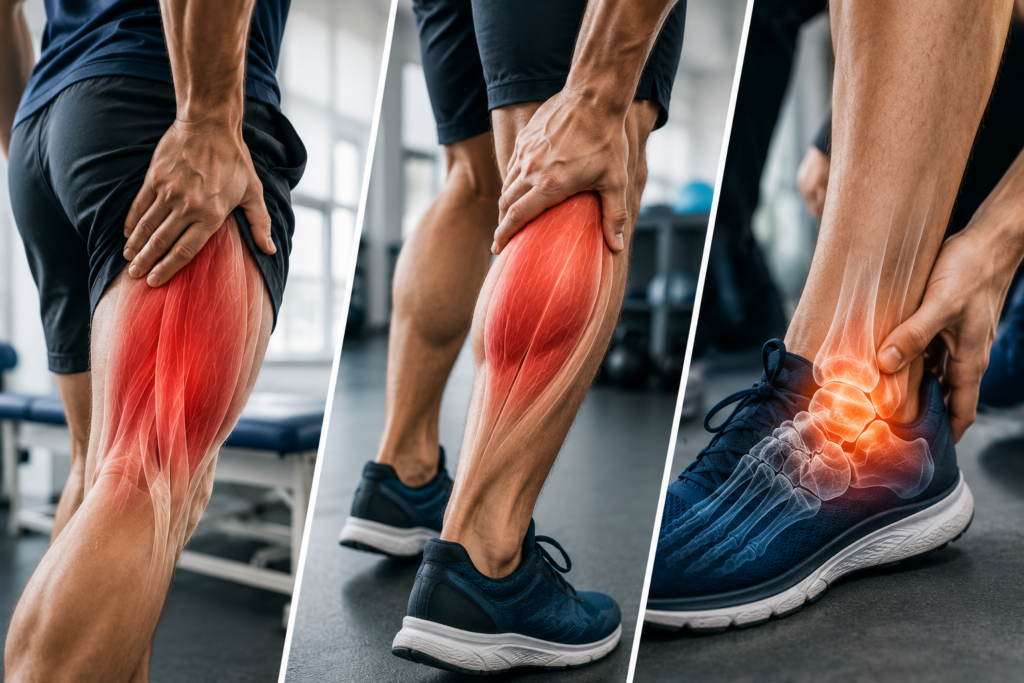
Whether you play Sunday league football at Moor Park, run with the Preston Harriers, or you are training for your first half marathon, lower-limb injuries are an almost inevitable part of being active. At Denovo Physio & Rehab in Preston, we specialise in getting recreational and serious athletes back to sport — properly, and without re-injury — using a combination of manual therapy, shockwave therapy, advanced electrotherapy and progressive rehab in our clinical gym.
This guide covers the three most common sports injuries we treat in Preston: hamstring strains, calf tears and ankle sprains, and exactly how our combined treatment approach gets you back to sport safely.
Why Sports Injuries Need More Than Rest
The old advice of RICE — rest, ice, compression, elevation — is now considered outdated. Modern sports rehabilitation follows the POLICE principle: Protection, Optimal Loading, Ice, Compression, Elevation. The word that matters most is loading. Tissues only heal properly when they are progressively challenged. Complete rest leaves you with weak, deconditioned tissue that re-injures the moment you return to sport.
Hamstring Strains
What Happens in a Hamstring Strain
Hamstring strains usually occur during sprinting, when the muscle is at its longest and working hardest to slow the leg down. Damage ranges from minor fibre disruption (Grade 1) to a full tear (Grade 3). The biceps femoris is the most commonly injured of the three hamstring muscles.
Hamstring Strain Recovery Timeline
- Grade 1 (mild) — return to sport in 1–3 weeks
- Grade 2 (moderate) — 4–8 weeks
- Grade 3 (severe / complete tear) — 3 months or longer, sometimes surgical
How Denovo Treats Hamstring Strains in Preston
- Manual therapy and soft tissue release to restore normal muscle length and accelerate scar tissue remodelling
- Advanced electrotherapy including VMS waveforms and Muscle Intelligence™ to reactivate the inhibited hamstring fibres after injury
- Shockwave therapy for chronic or recurrent hamstring tendinopathy at the sit bone (proximal hamstring tendinopathy)
- Progressive loading in our clinical gym — isometric holds, then eccentric strengthening (Nordic hamstring curls), then high-speed running and sport-specific drills
Skipping any stage dramatically increases re-injury risk — which is why up to 30% of hamstring strains recur within a year when not rehabbed properly.
Calf Muscle Strains and Tears
What Happens in a Calf Injury
Calf injuries usually affect the medial head of gastrocnemius — the inner half of your upper calf. The classic story is a sudden sharp pain during a sprint, push-off or jump, often described as feeling like you have been kicked in the back of the leg. Soleus injuries are deeper, more gradual in onset, and common in distance runners.
Calf Strain Recovery Timeline
- Mild calf strain — 1–3 weeks
- Moderate calf strain — 3–6 weeks
- Severe calf tear — 8–12 weeks
How Denovo Treats Calf Injuries in Preston
- Manual therapy and ankle joint mobilisation to restore normal dorsiflexion
- Soft tissue release of gastrocnemius and soleus
- Shockwave therapy for any coexisting Achilles tendinopathy, which often accompanies calf strains in runners over 40
- Advanced electrotherapy including Russian currents to reverse atrophy and rebuild calf strength
- Progressive heel raise programme and graded running progression
Ankle Sprains
What Happens in an Ankle Sprain
Ankle sprains — usually a lateral sprain affecting the anterior talofibular ligament (ATFL) — happen when the foot rolls inwards on landing. Around 70% of people who sprain an ankle once will go on to develop chronic ankle instability if they do not rehab properly the first time.
Why You Should Not Just ‘Walk It Off’
Ankle sprains stretch and damage ligaments and disturb the proprioceptive nerve endings that tell your brain where your foot is in space. Without proper balance retraining, your ankle stays vulnerable for months or years — even after the swelling has gone.
How Denovo Treats Ankle Sprains in Preston
- Manual therapy and joint mobilisation of the talocrural and subtalar joints
- Advanced electrotherapy for pain and swelling management in the acute phase
- Single-leg balance retraining, wobble board work and reactive agility drills in our clinical gym
- Structured return-to-sport programme with cutting and jumping progressions
Returning to Sport — Without Re-Injury
The single biggest predictor of re-injury is returning to sport before tissue has fully reconditioned. At Denovo, we use objective return-to-sport criteria — strength symmetry, hop testing, agility performance — not just how the injury feels. Our clinical gym, advanced electrotherapy and shockwave services give us tools that NHS pathways simply do not have access to.
Book Sports Injury Physio in Preston
Whether you are days into a new injury or stuck in a cycle of recurrent strains, we can help. Book an assessment at Denovo Physio & Rehab in Preston — we will give you an accurate diagnosis, a realistic timeline, and a structured rehab programme designed around your sport.
Call 01772 288065